Launch offer — valid today only

📄 Digital book in PDF · read it on your phone or print it

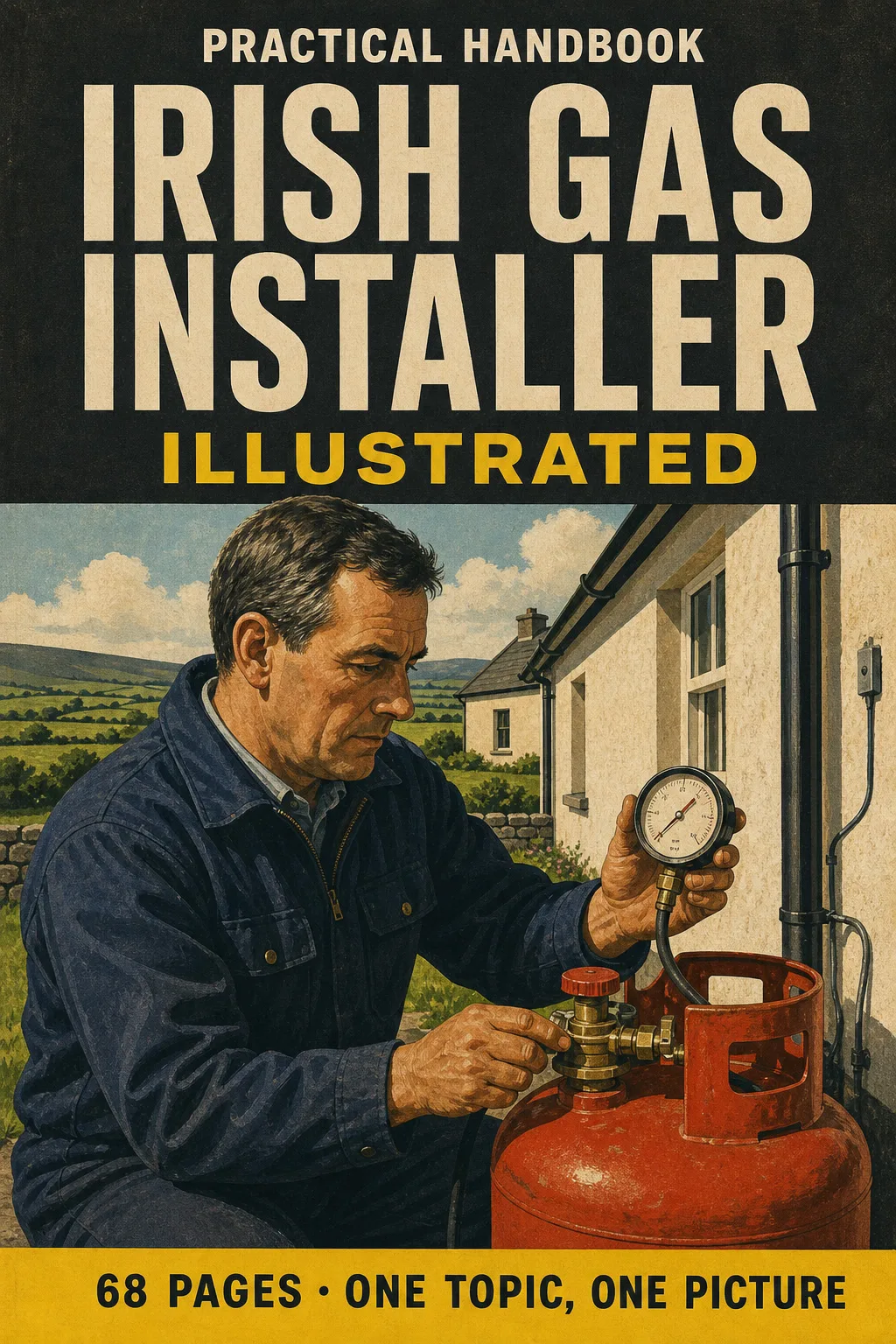
Domestic Gas Work and I.S. 813 in Drawings One Topic on Every Page

Tightness testing, purging, gas rating, ventilation, pipe sizing, flues, LPG siting and unsafe situations. Every topic has its own page: the drawing first, then what you need to remember. 68 illustrated pages.

START STUDYING THIS WAY

🔒 Secure checkout · PDF by email · 30-day guarantee

Every topic, its own pageEvery test and siting rule drawn, with the explanation beside it
68 illustrated pages9 parts, from the Irish gas framework to the night-before checklist
Up-to-date sourcesI.S. 813, I.S. 820 and I.S. 3216 (NSAI), plus Part J
PDF by emailFormat

Look Inside the Book

Every page has one big drawing and a box with the steps and values you need to know:

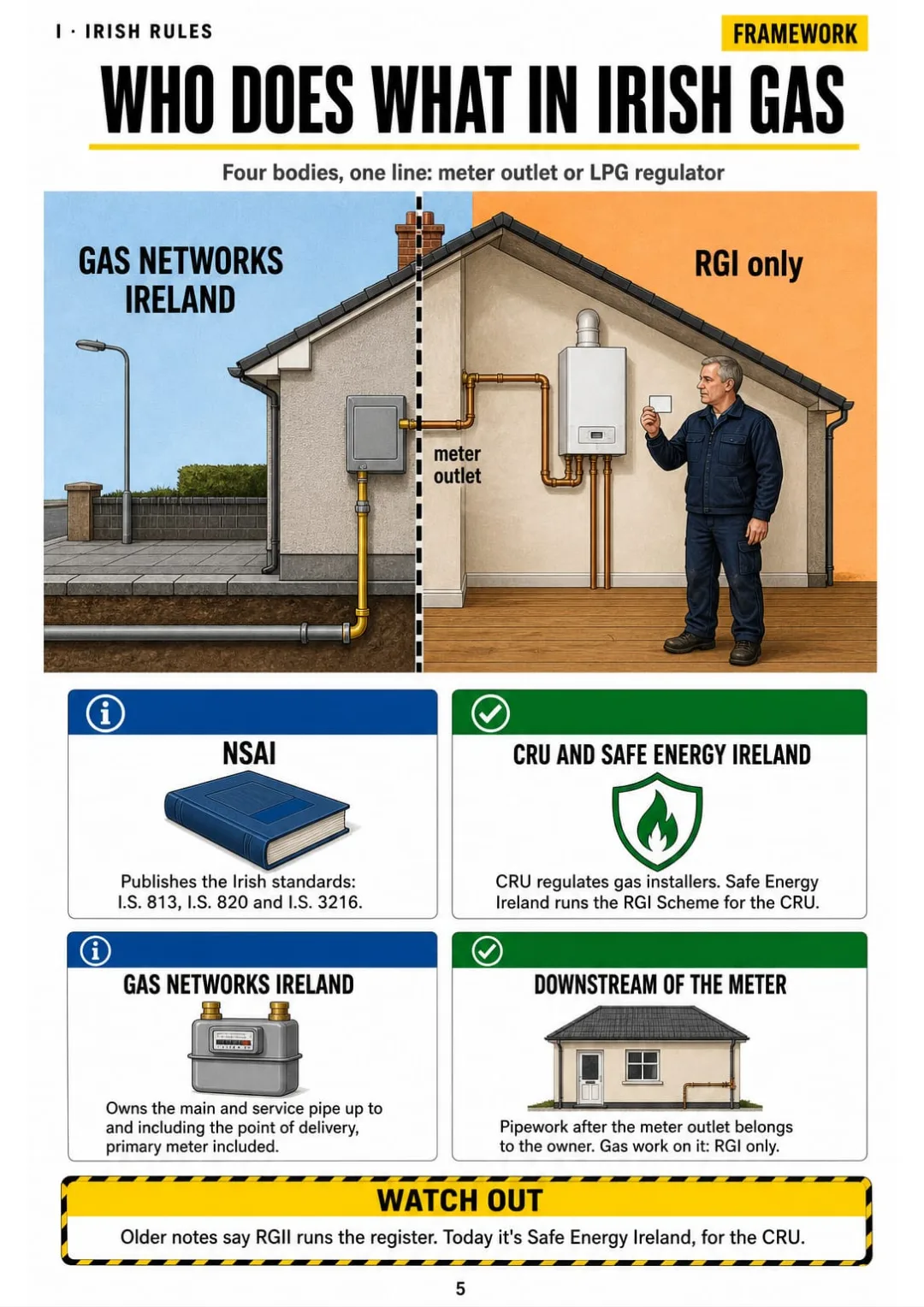
NSAI writes the standard, the CRU regulates, Safe Energy Ireland runs the RGI Scheme, GNI owns the meter.
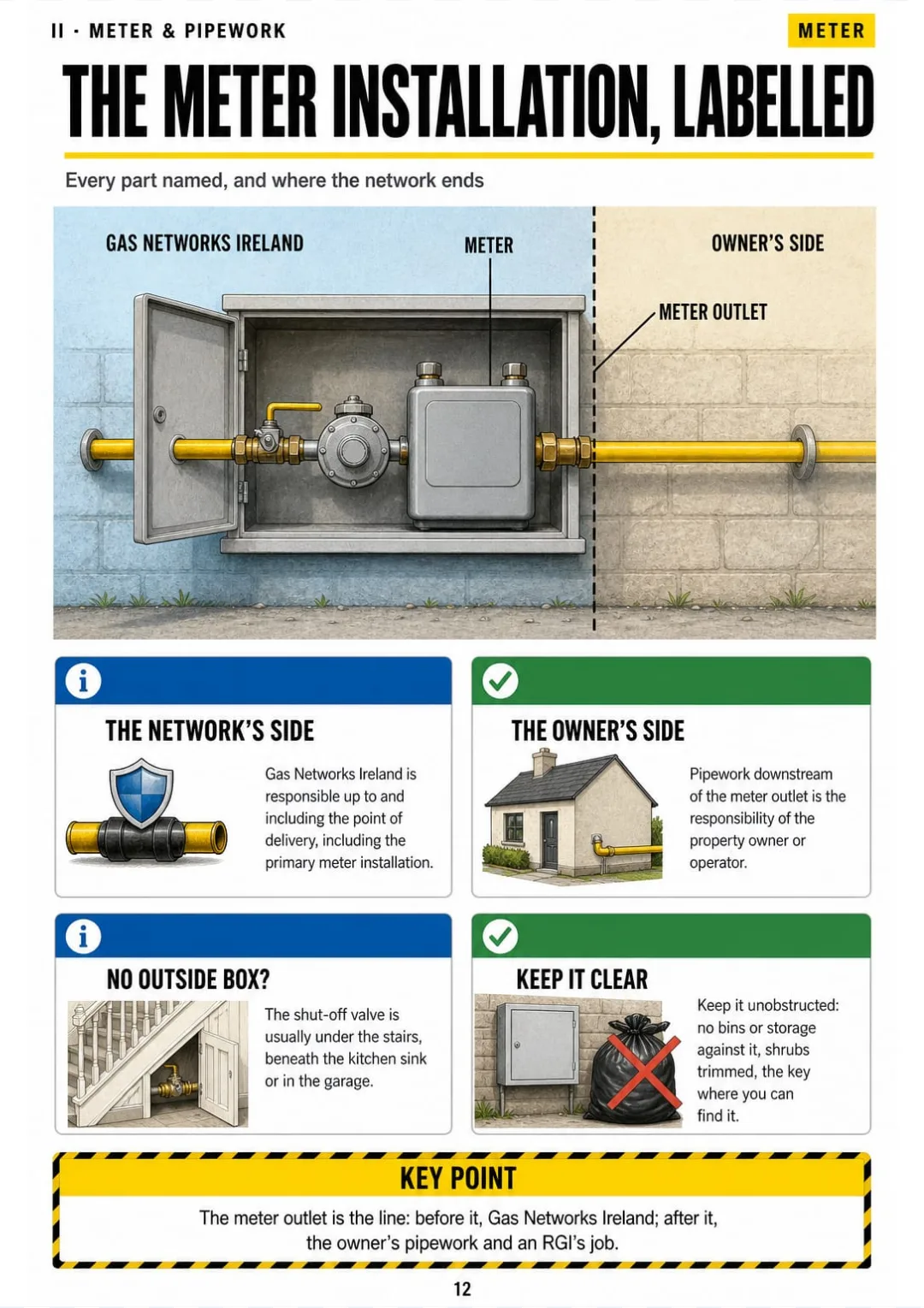
Meter box drawn and labelled: GNI up to the point of delivery, the owner after the meter outlet.
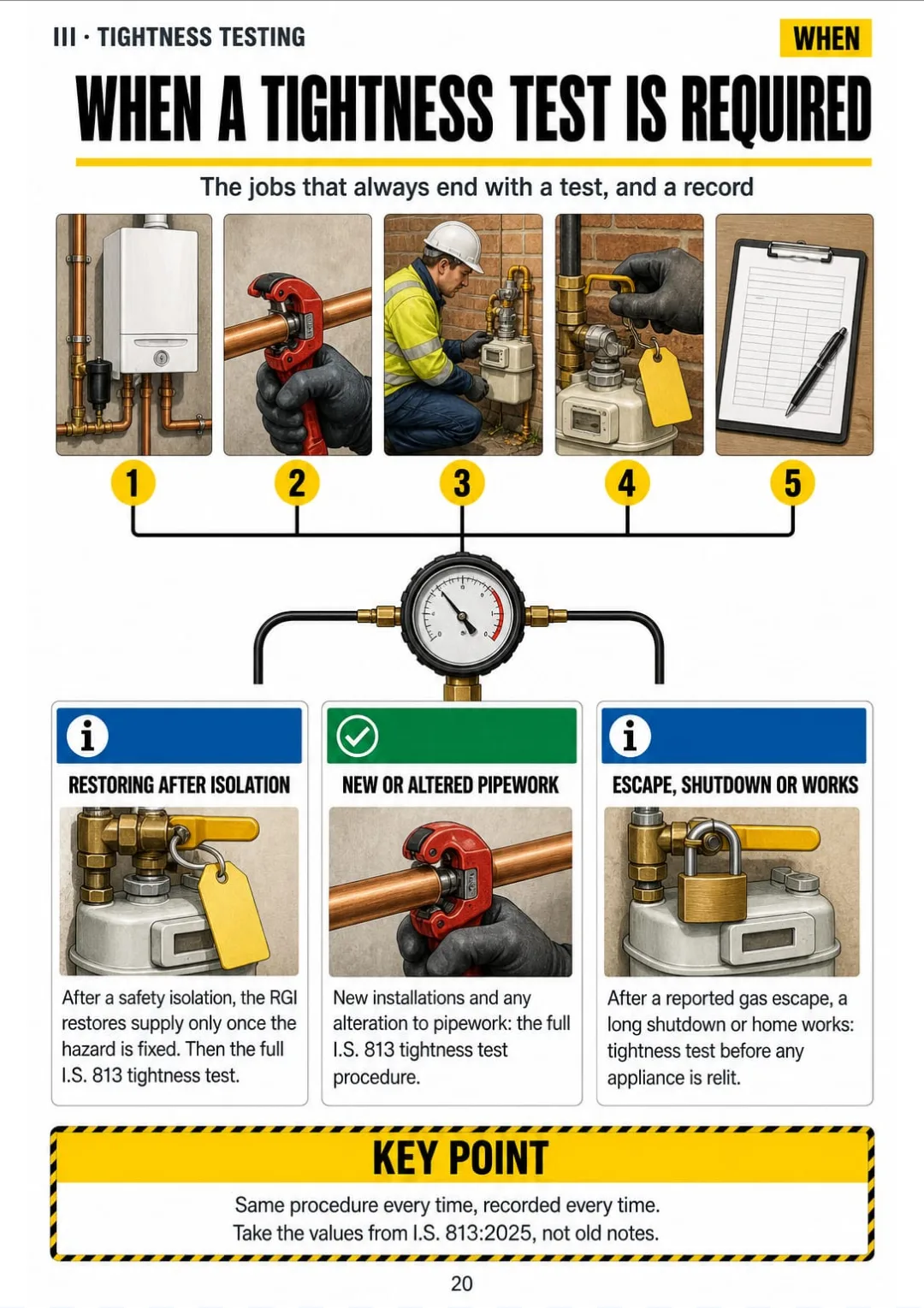
New work, altered pipework, a gas escape, restoring supply: each one ends with a recorded tightness test.
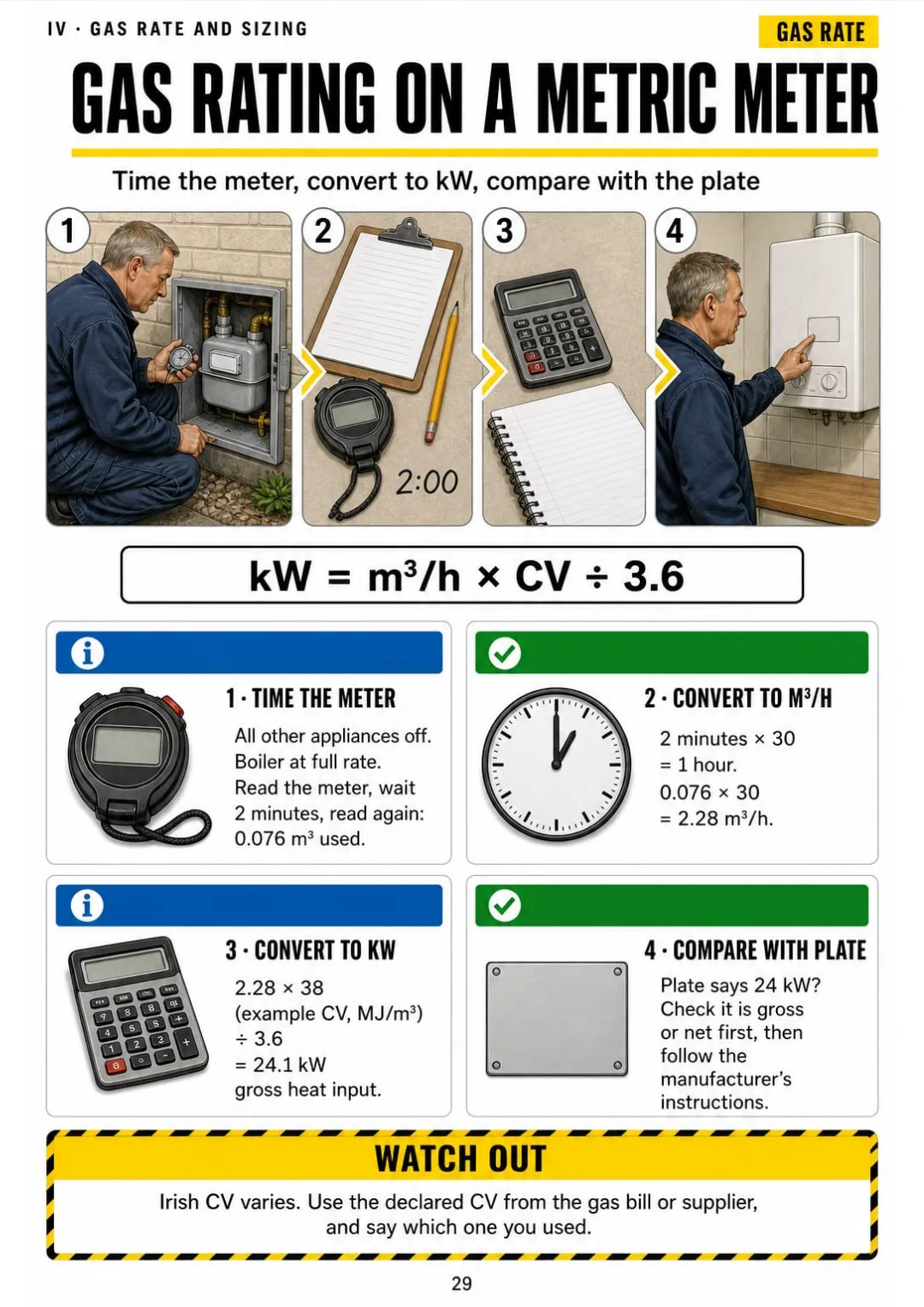
Gas rate: m³ in 2 min × 30 = m³/h; × CV ÷ 3.6 = kW.
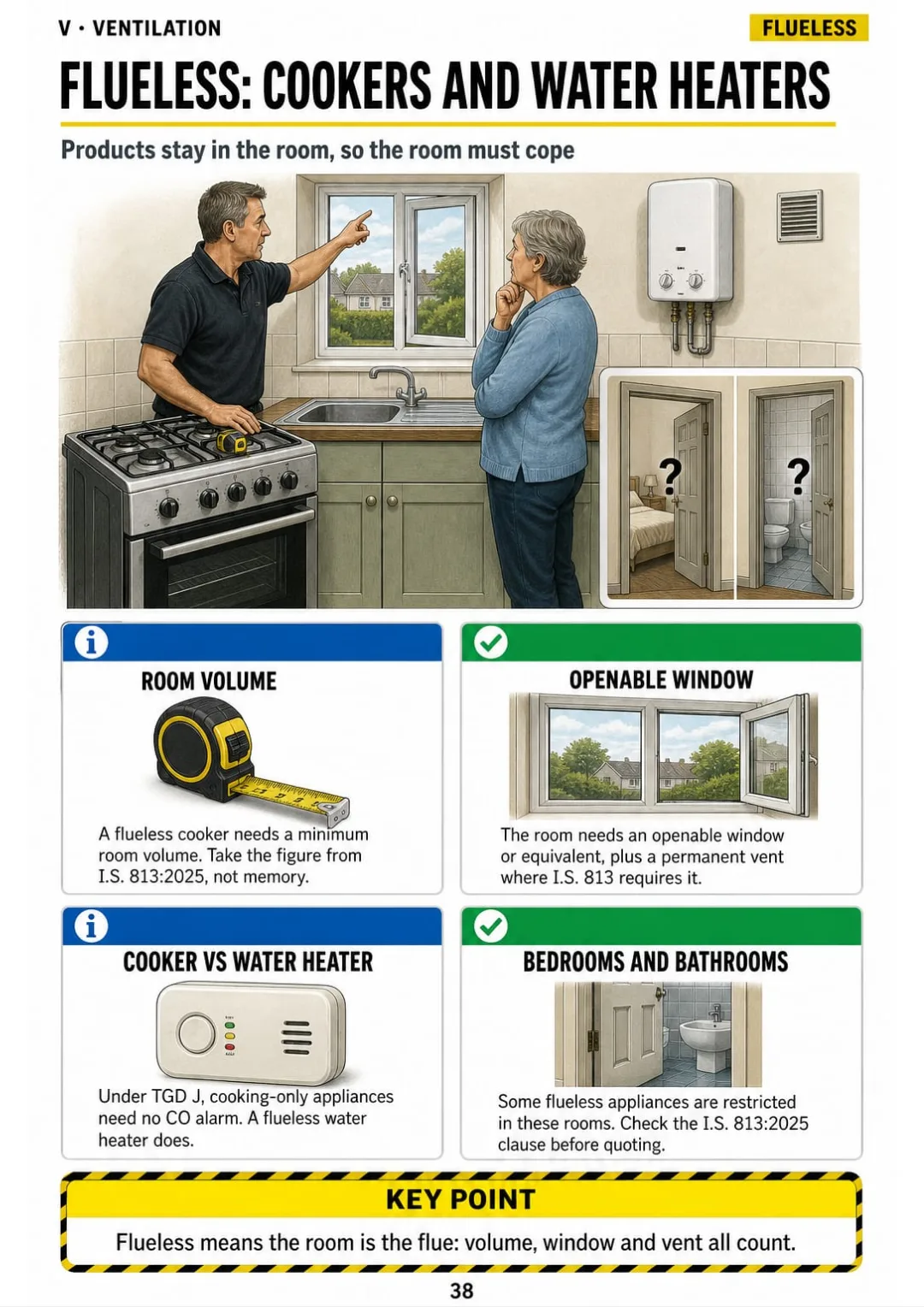
Flueless cooker or water heater: room volume, openable window, permanent vent.
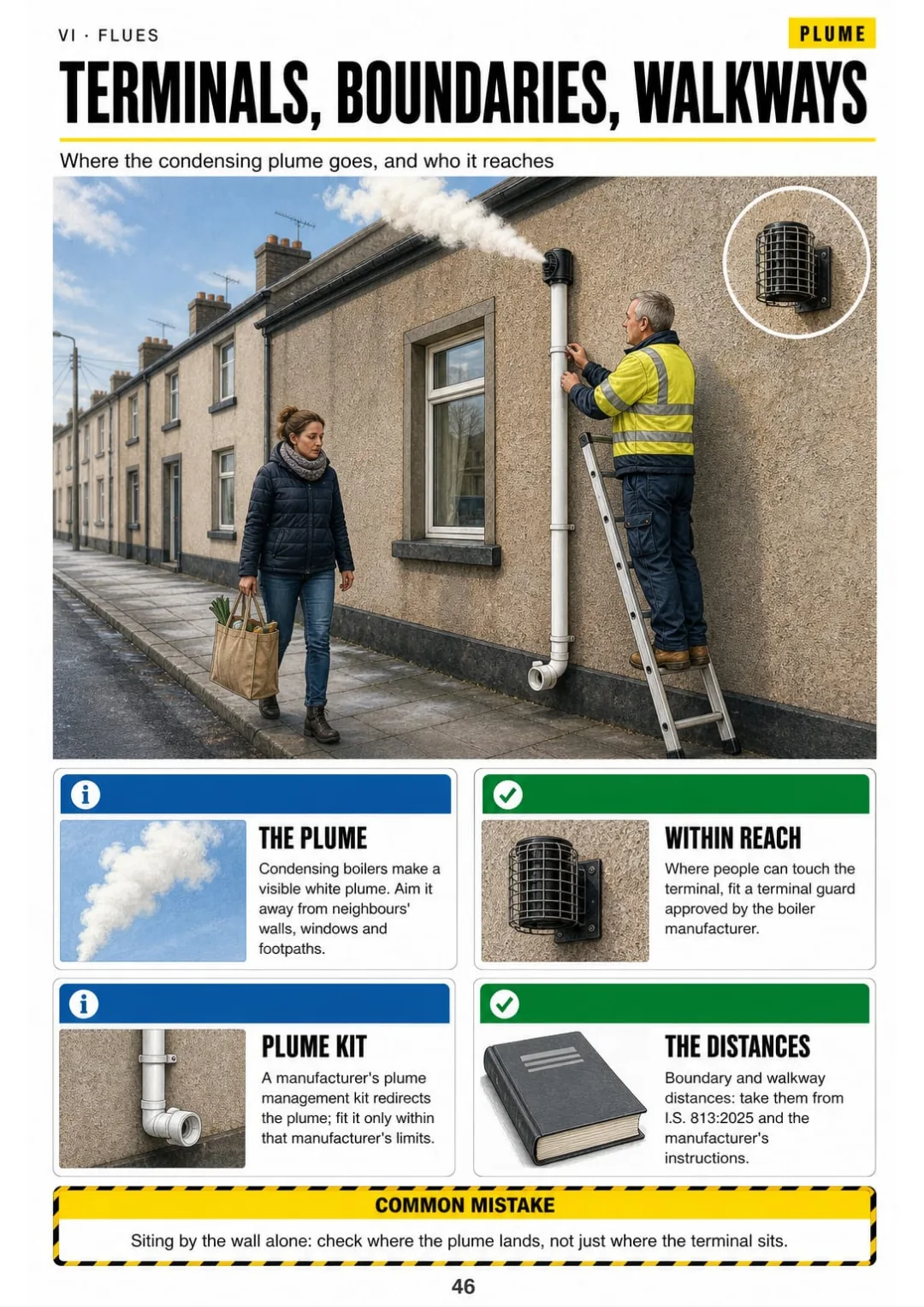
Plume near a neighbour's wall and a footpath: terminal guard and plume kit drawn
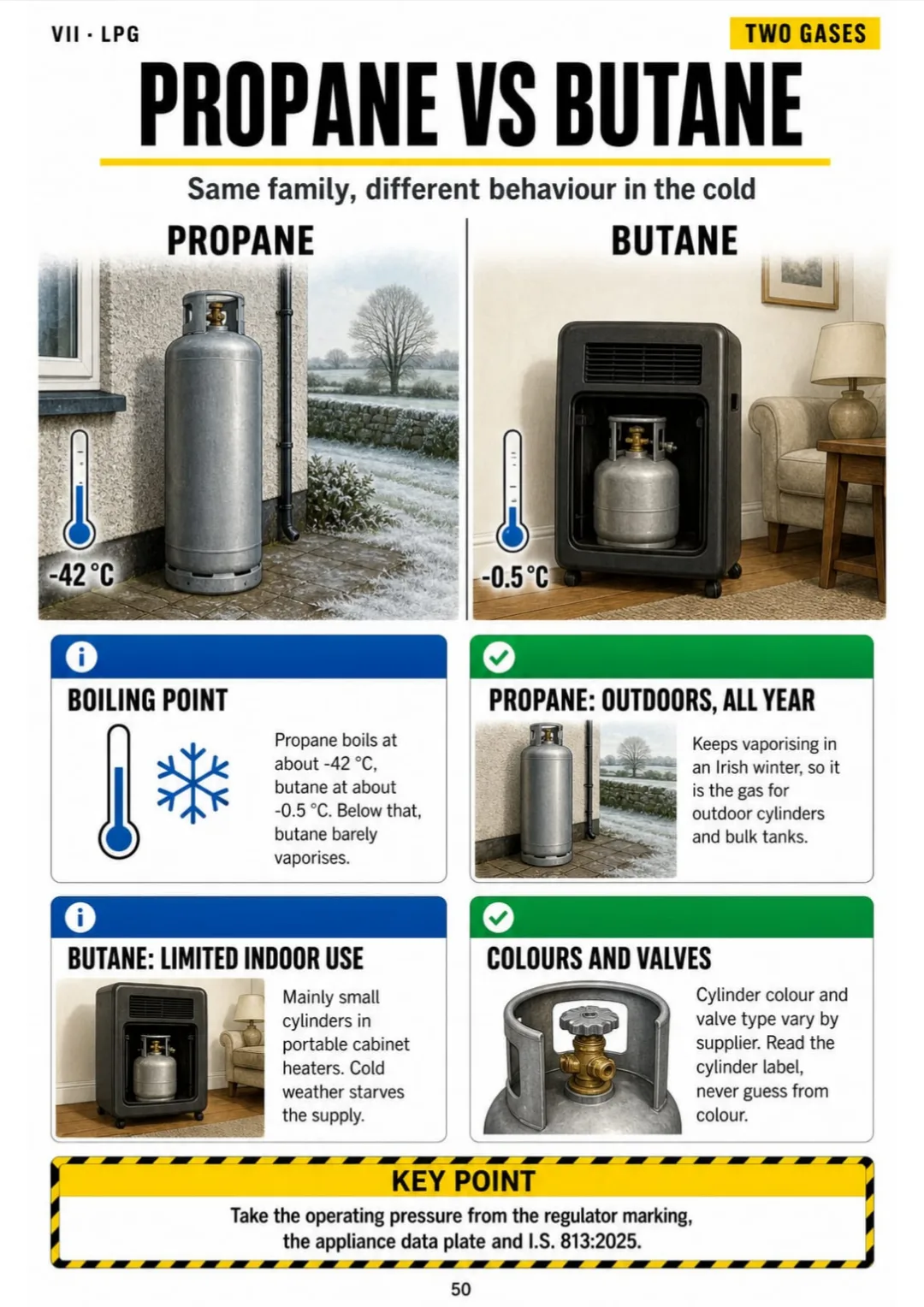
Propane boils at -42 °C, butane at -0.5 °C: that decides where each one goes.

Swipe to see more →

These are real pages from the book. The table of contents is the full one: 9 parts and 64 topics.

The Problem Isn't You. It's How It Was Explained to You.

You've just moved a boiler two metres along the wall, and the assessor asks: does this job need a tightness test? You know the work inside out. Still, you hesitate.

In the standard, the answer is spread across clauses and cross-references. The rule is there, but it's buried in paragraphs you read once at night and lose by morning.

New work, altered pipework, a gas escape, restoring supply: each one ends with a recorded tightness test.

In the book, it's one page: new work, altered pipework, a gas escape, restoring supply, each one drawn in its own box, and every one ends with a recorded tightness test.

The same goes for the meter installation, gas rating on a metric meter, why appliances need air, flue types and propane versus butane: each one has its page.

So when the question comes, you see the page in your head and give the answer, without going back to the standard.

COMPARE FOR YOURSELF

The Same Topic, Two Ways to Study It

THIS
  • Text-only notes: one clause after another
  • Meter, ECV and regulator explained only in words
  • You go into the assessment unsure
The meter installation shall comprise the service pipe termination, the emergency control valve, the regulator where fitted, the meter and the outlet connection, and responsibility for each component shall be determined with reference to the point of delivery as defined by the network operator. Components upstream of the point of delivery remain the responsibility of the gas transporter, while the installation pipework downstream of the meter outlet connection shall be the responsibility of the owner or occupier, who shall ensure it is installed and maintained by a registered installer.
FOR THIS
  • The meter box in one labelled drawing
  • Who owns what, in one box
  • You see it and you get it
Meter box drawn and labelled: GNI up to the point of delivery, the owner after the meter outlet.
CONTENTS

Take a Look at the 9 Parts and 64 Topics

The Irish rules, meter and pipework, tightness testing and purging, gas rate and pipe sizing, ventilation, flues, LPG, non-domestic work and unsafe situations, and a final revision part: 68 pages, all illustrated

IGas and the Irish Rules · pp. 5-11
  1. Who does what: the Irish gas framework
  2. I.S. 813, I.S. 820, I.S. 3216: which one applies
  3. Natural gas vs LPG: two gases, two behaviours
  4. Supply pressures you must know
  5. The combustion triangle and complete combustion
  6. Carbon monoxide: why it kills quietly
  7. Units on the job: mbar, kW, m³, MJ
IIMeter, Valves and Pipework · pp. 12-19
  1. The meter installation, labelled
  2. The emergency control valve (ECV)
  3. Pipe materials allowed indoors and outdoors
  4. Joints: what goes where
  5. Running pipe through walls and floors
  6. Pipe supports and clearances from electrics
  7. Protective equipotential bonding
  8. Appliance isolation and connections
IIITightness Testing and Purging · pp. 20-28
  1. When a tightness test is required
  2. Your test kit: manometer and test point
  3. Step 1: visual inspection
  4. Step 2: let-by test on the ECV
  5. Step 3: stabilisation
  6. Step 4: the test period and permissible drop
  7. Finding a leak, then retesting
  8. Purging: why and how much
  9. Purging complete: how you know
IVGas Rate and Pipe Sizing · pp. 29-34
  1. Gas rating on a metric meter
  2. Burner pressure and data plates
  3. Pressure loss: the rule behind pipe sizing
  4. Using the pipe sizing table
  5. Worked example: boiler, hob and fire
  6. Adding an appliance to an existing system
VVentilation · pp. 35-41
  1. Why appliances need air
  2. Room-sealed: no room vent for combustion
  3. Open-flued appliances: permanent ventilation
  4. Flueless appliances: cookers and water heaters
  5. Compartments: high and low vents
  6. Free area vs grille size
  7. Extract fans and spillage
VIFlues and Terminals · pp. 42-49
  1. Flue types at a glance
  2. Open flue: how a flue draws
  3. Flue spillage test
  4. Terminal siting: the house plan
  5. Terminals near boundaries and walkways
  6. Condensing boilers and the condensate pipe
  7. Flue in voids and ceiling spaces
  8. Chimneys and liners for gas fires
VIILPG: Cylinders and Bulk Tanks · pp. 50-56
  1. Propane and butane: the differences
  2. Regulators, OPSO and UPSO
  3. Cylinder siting outside the house
  4. Changeover valves and pigtails
  5. Bulk tanks: separation distances
  6. Bulk tank surroundings and access
  7. LPG leaks: low points and cellars
VIIINon-domestic, Unsafe Situations and Paperwork · pp. 57-63
  1. I.S. 820: what changes in non-domestic work
  2. Commercial kitchens: the ventilation interlock
  3. Plant rooms and boiler houses
  4. Hazard vs Non-Conformance
  5. Responding to a reported gas escape
  6. CO alarms under Part J
  7. Commissioning and the Declaration of Conformance
IXRevision Before the Assessment · pp. 64-68
  1. The tightness test on one page
  2. Ventilation and pipe sizing: the formulas
  3. Clearances and distances at a glance
  4. Most frequent mistakes in the assessment
  5. Your night-before checklist

One Page, One Topic, All Clear

Think of it this way:

You're commissioning a new boiler and you need its gas rate before you sign off. The meter is in front of you and the stopwatch is running.

You open the page on gas rating on a metric meter: m³ in 2 minutes × 30 gives m³/h, then × CV ÷ 3.6 gives kW, worked through on a drawn meter.

Flueless cooker or water heater: room volume, openable window, permanent vent.

Same with the tightness test, ventilation, flue types, LPG cylinder siting and Hazard vs Non-Conformance: each one on its own page.

Irish Gas Installer Illustrated is 9 parts and 64 topics, all drawn, with a revision part at the end: the tightness test on one page, the formulas and the distances at a glance.

What you see drawn, you don't have to memorize.

What's Inside Irish Gas Installer Illustrated:

Ipp. 5-11

Gas and the Irish Rules

Who does what in Irish gas, which standard applies, natural gas vs LPG, supply pressures, combustion, carbon monoxide and the units you use on the job.

IIpp. 12-19

Meter, Valves and Pipework

The meter installation labelled, the ECV, pipe materials, joints, sleeving through walls and floors, supports, bonding and appliance connections.

IIIpp. 20-28

Tightness Testing and Purging

When a test is required, your manometer and test point, the four steps from visual inspection to permissible drop, finding a leak and purging.

IVpp. 29-34

Gas Rate and Pipe Sizing

Gas rating on a metric meter, burner pressure, pressure loss, the pipe sizing table and a worked example with boiler, hob and fire.

Vpp. 35-41

Ventilation

Why appliances need air, room-sealed, open-flued and flueless appliances, compartment vents, free area and extract fans.

VIpp. 42-49

Flues and Terminals

Flue types at a glance, how an open flue draws, the spillage test, terminal siting, condensate pipes, flues in voids and chimney liners.

VIIpp. 50-56

LPG: Cylinders and Bulk Tanks

Propane vs butane, regulators with OPSO and UPSO, cylinder siting, changeover valves, bulk tank distances and LPG leaks at low points.

VIIIpp. 57-63

Non-domestic, Unsafe Situations and Paperwork

What changes under I.S. 820, kitchen interlocks, plant rooms, Hazard vs Non-Conformance, gas escapes, CO alarms and the Declaration of Conformance.

IXpp. 64-68

Revision Before the Assessment

The tightness test on one page, the formulas, clearances at a glance, the most frequent mistakes and a night-before checklist.

At the end of the book: A revision part with the tightness test on one page, the formulas and all clearances at a glance.
Plus: 2 Free Books

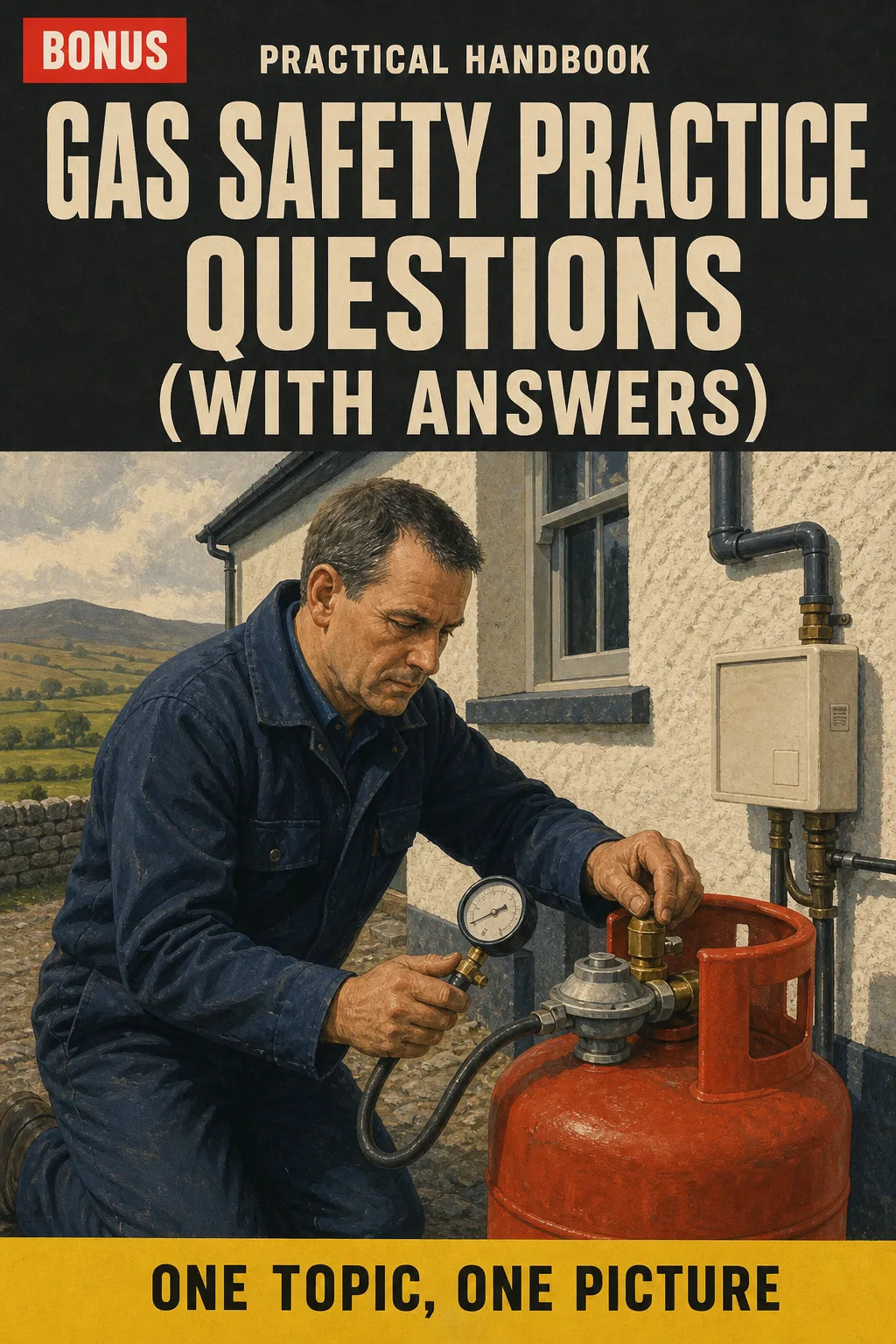
Gas Safety Practice Questions (with Answers)

BONUS 1: «Gas Safety Practice Questions (with Answers)»

Value on its own: US$ 17.90

Exam-style questions on every chapter, each answer explained, so you find out what you've forgotten before the assessment does.

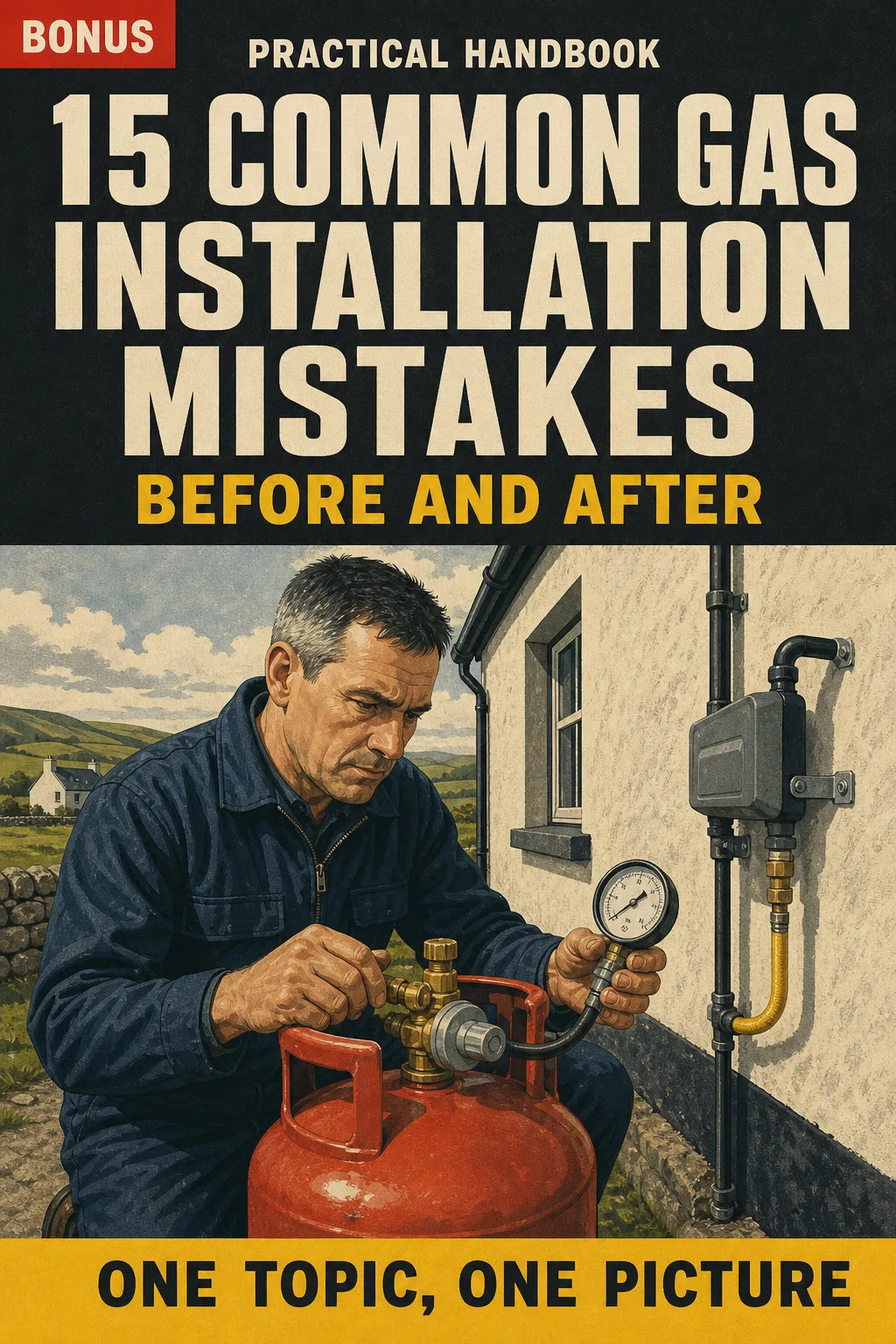
15 Common Gas Installation Mistakes: Before and After

BONUS 2: «15 Common Gas Installation Mistakes: Before and After»

Value on its own: US$ 14.90

The most frequent errors on tightness tests, ventilation, flues and LPG siting, each one drawn wrong and then right, to check at a glance.

Irish Gas Installer Illustrated with 2 Free Books

  • Irish Gas Installer Illustrated: 68 illustrated pagesUS$ 63
  • BONUS 1: Gas Safety Practice Questions (with Answers)US$ 17.90
  • BONUS 2: 15 Common Gas Installation Mistakes: Before and AfterUS$ 14.90
  • High-resolution PDF to printIncluded
Total value US$ 95.80
YOUR PRICE:
US$ 27
You save US$ 68.80
YES, I WANT IRISH GAS INSTALLER ILLUSTRATED FOR US$ 27

📄 This is a digital PDF book sent to your email: nothing is printed or shipped.

Secure purchaseEncrypted payment30-day guarantee

PDF by email: We email you Irish Gas Installer Illustrated as a PDF, together with the two free books. It's a single payment: no installments, no extra charges.

Who This Book Is For

You're on the QQI gas safety course

You're on the QQI gas safety course

Each module has its page, drawn, so what you covered in class is still there the next evening.

Your assessment is coming up

Your assessment is coming up

The revision part puts the tightness test, the formulas and the distances on a few pages you can go through the night before.

You're already a Registered Gas Installer

You're already a Registered Gas Installer

Catching up with I.S. 813? Keep it printed in the van: when an inspector asks why you did something, you know which page the rule is on.

Everything You Get Today

US$ 95.80US$ 27
YES, I WANT IRISH GAS INSTALLER ILLUSTRATED FOR US$ 27

📄 This is a digital PDF book sent to your email: nothing is printed or shipped.

30DAYS
GUARANTEE

30-Day Guarantee

Try Irish Gas Installer Illustrated for 30 days, bonus books included.

We refund everything if the file won't open, if the book isn't what you see here, if you were charged twice or if the email doesn't arrive. Just email us.

You pay once. No subscriptions.

Frequently Asked Questions

Is it for me if I've been in the trade for years and I'm only now doing the gas safety course?

Yes. It isn't a beginner's book: it's written for working plumbers and heating engineers, in short sentences, with the rules and values you use on site. It covers domestic work to I.S. 813 in full, with one part on what changes under I.S. 820 for non-domestic work.

Where does the content come from?

From the Irish standards published by the NSAI (I.S. 813, I.S. 820 and I.S. 3216) and Part J of the Building Regulations, checked against the current editions. Irish rules and metric units, not UK or BS material.

Is it official material?

No. It's an independent study book, not published or endorsed by the NSAI, Safe Energy Ireland, Gas Networks Ireland or QQI. It doesn't give you a certificate or a qualification: it's for studying and revising.

Does it replace the course?

No. It doesn't replace QQI training, the published standards or the assessment. In Ireland, gas work may only be carried out by a Registered Gas Installer.

Are the practice questions the ones in the assessment?

No. They're written for this book to help you revise each chapter. They aren't official questions from any assessment.

When and how does it arrive?

The book and the 2 bonuses arrive as a PDF by email, at the address you enter at checkout.

Do I have to pay every month?

No. It's a one-off payment.

Can I have it on paper?

Yes. The PDF prints cleanly at home or in a print shop, so you can keep it in the van.

How does the refund work?

You have 30 days. We refund everything if the file won't open, if the book isn't what you see on this page, if you were charged twice or if the email doesn't arrive: just email us.

Before You Close This Page

No more rereading the standard and keeping nothing.

The tightness test is drawn step by step, and that's it.

You walk into the assessment knowing where everything is.

Drawings make studying faster.

The book is right below.

One-time payment: US$ 27 · Guarantee: 30 days · PDF by email

YES, I WANT IRISH GAS INSTALLER ILLUSTRATED FOR US$ 27

📄 This is a digital PDF book sent to your email: nothing is printed or shipped.